A collaborative working paper from the roundtable convened under the Louisville Institute’s 2025-2026 Pastoral Study Project

Charts Don't Matter
Citation: Skaggs, Michael; Tucker Edmonds, Joseph; Callahan, Jason; Faris, Kara; Iten, Benjamin; Koh, SueJeanne, and Watts Henderson, Suzanne. (2026). “Charts don’t matter — but relationships do.” Chaplaincy Innovation Lab. https://chaplaincyinnovation.org/resources/working-papers/charts-dont-matter

Introduction
Our project set out to grapple with one of the most contentious issues in the public square today: what to do about religion.
In 2022, Pew reported on persistent and sharp divisions over the role of religion in public life, including religion’s influence and whether houses of worship and faith leaders should speak on political issues or candidates. In February 2024, the same organization polled Americans and found that 72% of religiously “unaffiliated” adults said “conservative Christians have gone too far in trying to control religion in the government and secular schools.” In the same study, Pew found that 63% of Christians felt the same way about “secular liberals.” Yet these divisions don’t only reflect Americans’ thoughts on American issues: religion has come under sharp debate in public life as its adherents are conflated with geopolitics within and well beyond the United States.
The upshot of this statistical tangle is that American society has a religion problem. Our project set all the above issues aside. It also intentionally sidelined the political implications that often follow debates over the role of religion in public life. Instead, we drew on the profession of chaplaincy and its inherent privileging of individual meaning and purpose to address social crises. These dual foci of meaning and purpose are not new, but gathering leaders with starkly contrasting beliefs on religion and spirituality, as well as an enormous variety of professional backgrounds, offers a new opportunity to reduce division and model cooperation and collaboration on matters that don’t map onto panic-inducing graphs but rather affect real people in real communities.
At the beginning of this project, the Chaplaincy Innovation Lab set out to compile a roundtable of leading thinkers on religion and society in the United States, prizing diversity in professional background, philosophical and demographic self-identification, and ways of engaging communities. The roundtable model results from just how difficult and multifaceted are questions around identity and belonging: rather than attempting to tackle some enormous problem in the compressed timeframe available to us, we determined to spend our limited time together sharing our experiences, perspectives, and local circumstances. We are deeply grateful for the Louisville Institute‘s 2025-2026 Pastoral Study Project program, which supported our work together. Under the leadership of Director of Lab Programs Michael Skaggs, our roundtable is as follows:

Jason S. Callahan serves as an instructor in the Department of Patient Counseling, College of Health Professions, and as a chaplain for the Thomas Palliative Care Unit in VCU Massey Cancer Center. There, he provides pastoral care to patients, families and staff. He holds an M.S. in Patient Counseling from Virginia Commonwealth University. He is a Board Certified Chaplain with the Association of Professional Chaplains and is endorsed by The Humanist Society. Prior to VCU, Jason worked as an advertising executive and as a counselor for individuals and families in crisis.
Recently Jason was featured on Interfaith Voices, the nation’s leading religion news magazine on public radio in a segment called “Humanizing Pastoral Care,” which was a part of an hour-long broadcast: “Chaplains Part IV: Humanism at Harvard.”
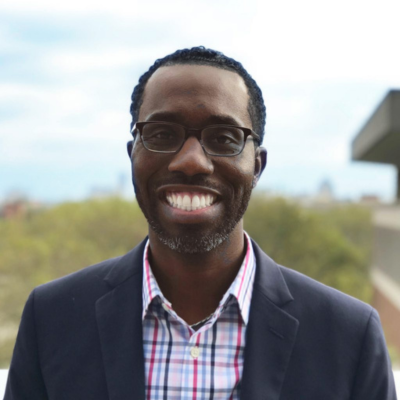
Joseph L. Tucker Edmonds is an Associate Professor of Religious Studies and Africana Studies at Indiana University Indianapolis and the Associate Director of the Center for the Study of Religion and American Culture. He earned his Bachelor of Arts in Religious Studies and Economics from Brown University, his Master of Divinity from Union Theological Seminary in New York City, and his PhD in Religious Studies from Duke University.
Professor Tucker Edmonds’ research interests are Black religion and the Black body, alternative Christianities, and the role of scripture in African and African American religious traditions. In addition to his focus on institutions and practices of resilience and resistance in African American communities, Tucker Edmonds is an award- winning teacher and an engaged scholar. He is the former president of the local Indianapolis branch of the Association for the Study of African American Life and History (ASALH) and is a member of the editorial board of Religion and American Culture: A Journal of Interpretation. Tucker Edmonds’ book, The Other Black Church: Alternative Christian Movements and the Struggle for Black Freedom (Fortress 2020), highlights the variety and vibrancy of the African American Christian sphere during the latter half of the twentieth century and it adds to the growing body of work that is addressing alternative Christian traditions in the Black public sphere.
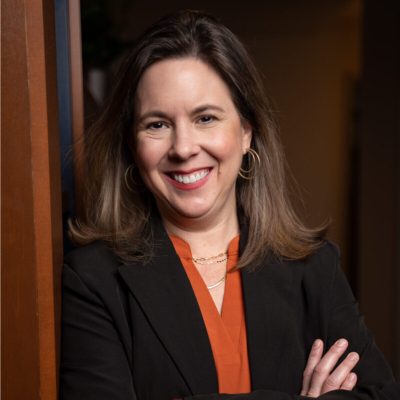
Kara Faris is the Center for Congregations Executive Program Director. Over her time at the Center, she has also served as the director of resource grants and resource consulting and the education director.
Before working at the Center, Kara served First Friends Meeting of Indianapolis as associate pastor. With a degree in marketing from Butler University’s College of Business Administration and a master of divinity degree from Christian Theological Seminary, Kara brings a blend of pragmatism, intuition and passion for lifelong learning to the Center. Kara has authored “Including Laity in Education Events Empowers Congregations” and co-authored the book Divergent Church.
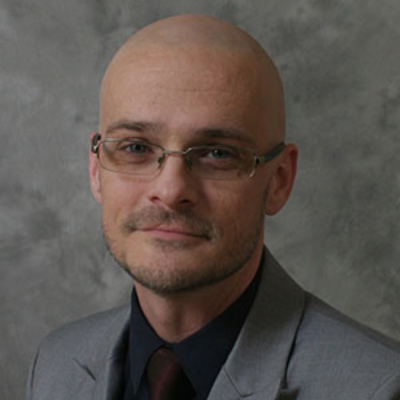
Ben Iten is President and Chaplain Committee Chair of The Humanist Society. He is now an endorsed Humanist Chaplain, but he was raised in the evangelical church. Over time his academic studies in Judaism (at The Ohio State University) and Bible Interpretation (at the University of Oxford) challenged him to rethink how he understood religion and spirituality. Eventually this rethinking led him to humanism and its progressive outlook on life. Humanist values continue to inspire Ben’s work as a professional chaplain for a major hospital system where he helps people find their inherent worth and dignity. When he’s not out visiting patients, he’s teaching new chaplains and volunteering with his local AHA chapter, the Humanist Community of Central Ohio. He is the first Humanist Chaplain certified by the Humanist Society to seek certification from the Association for Clinical Pastoral Education as a Certified Educator.
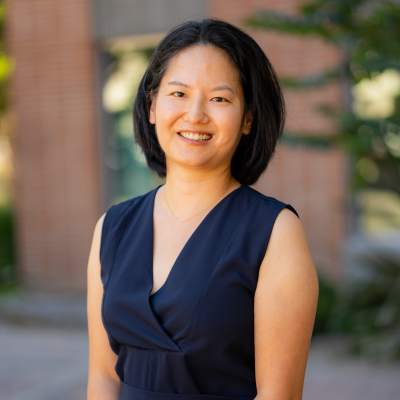
SueJeanne Koh is the Assistant Director of Graduate Futures and Research Engagement at the Humanities Center at the University of California, Irvine. In her position, she develops programming for humanities PhD students on professional development and diverse career pathways. She is also a writer and teacher in Christian theology and ethics who has published on academic contingency, Asian American and Reformed theology, and settler colonialism. SueJeanne is invested in building collaborations across educational institutions, religious communities, and nonprofit organizations to address social and political challenges, and sustainable organizational practices. From 2023 to 2025, she was an interfaith partner with The Wildland-Urban Interface Climate Action Network (WUICAN), a collaboration between the University of California, Irvine, UC Riverside and UC San Diego, Tribes, community groups, and land managers that are working together to address the climate crisis. She is ordained as a teaching elder in the PC(USA) and is on staff at St. Mark Presbyterian Church in Newport Beach, CA.
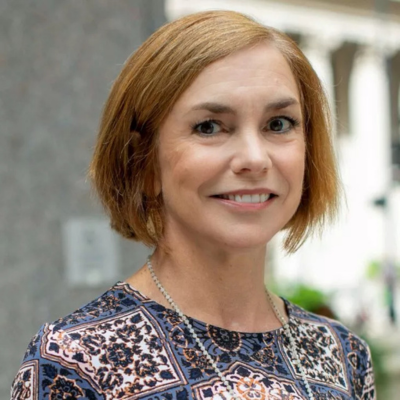
Suzanne Watts Henderson is Senior Director of Faith and Health at Interfaith America. She consults mainly with the strategic initiatives team, leading Interfaith America’s growing exploration at the intersection of faith and health. An ordained Disciples minister and New Testament scholar, Suzanne has spent the last two decades in higher education, serving as professor and dean of the chapel and leading efforts to embed religious pluralism across campus units. Despite her Duke doctorate, Suzanne’s basketball loyalties lie with UNC, where she majored in English. In between, her time at Princeton Seminary brought both a degree (M.Div.) and a spouse, with whom (more than three decades later!) she now shares an outdoor-oriented, travel-happy, empty-nest life based in Charlotte, with frequent visits to adult children in DC, Denver, and LA.
What do you mean “charts don’t matter”?
Anyone who follows religion in the news is familiar with the brightly colored charts, often shared in and commented upon on social media, predicting the imminent demise of some tradition, the explosive growth in another, or the disappearance of religion altogether. Books with titles like The Vanishing Church: How the Hollowing Out of Moderate Congregations Is Hurting Democracy, Faith, and Us; or Why Religion Went Obsolete; or Goodbye Religion: The Causes and Consequences of Secularization would all seem to suggest both that religion is dead in the United States, and that this has some sort of enormous implication for our communities.
Worthy though these authors are of serious engagement, we think such titles tell us more about how to sell books than they do about the lived reality of Americans in their communities. As Suzanne Watts Henderson said during one of our discussions, “when we’re discussing charts, we’re really thinking of categories and markers…it’s a checkbox kind of survey data, and by their very nature this way of extracting information is reductionistic.” To be sure, data is important, and we should continue to gather it! As Suzanne said, hard data “keeps us honest.” But it is not, in the end, the “truest and best reflection of reality.”
Ben Iten, president of the Humanist Society, brought his institution’s perspective to bear on contemporary narratives around religious affiliation and the discrepancy between statistics and reality. If a person reports not attending a religious congregation, such a report could very well mean “they’re just not going to church. Maybe they’re still holding the theology and the values.” More significant, then, in lived experience is the social impact that attending a congregation – regardless of its animating philosophy. “People are finding different ways to find meaning in their lives…and find[ing] community in different places.” Ben also clarified that viewed from this perspective, the “why” behind a declared affiliation is not a binary between religion and its absence; socially-nurtured meaning and fulfillment can be discovered and created in a variety of communities, but religious belief is not necessary for communities to create meaning.
We do not suggest, of course, that pollsters and researchers should stop collecting data on the demographics of belief – whatever that belief may be. A greater understanding of our own society will always tend toward social benefit in the long term. But what we might call the “moralization” of data, how that data is presented, and the narratives extrapolated therefrom – which are debatable – all can be liabilities to the actual communities in which we live. This is especially true when reported data strongly suggests deep divisions that may not even be perceived in everyday interactions between real people; the questions themselves – such as the ones above about “conservative Christians” and “secular liberals” and each groups’ ostensible influence on American society – can raise the specter of conflict and foster mistrust. Such framing presumes a straitened social-religious-philosophical configuration and overlooks the rich nuance that has characterized Americans’ religious and philosophical identities almost from the nation’s beginning. One need remember only, for instance, that there are such things as “liberal Christians” and a “religious liberals,” yet such identities were overlooked in the question above – further fueling a sense of disconnection between and among communities.
What social problems can religious and non-religious groups address together?
One of our roundtable’s conversations was dedicated to a program presented by SueJeanne Koh: the Wildland-Urban Interface Climate Action Network (WUICAN, or “We Can”), which began at the University of California Irvine (UCI) and includes significant interfaith cooperation “to develop…a new model of co-governance for land stewardship and climate action policies.” The Network naturally includes participation by Indigenous groups, which poses a challenge to the basic assumptions that often undergird what we call “interfaith” initiatives: what happens when a spirituality does not fit neatly into what are often historically Euro-centric conceptions of religion, the sacred, and the natural world? The Network’s partners are now actively engaging this question directly, especially by exploring “the relationship between UCI and the Acjachemen and Tongva communities, on whose ancestral lands the university exists.” The Network’s Interfaith Climate Action Group also gathers resources from local faith communities, including those in the Christian, Jewish, and Sikh traditions, to identify “faith-based tools and frameworks that confront the climate crisis.”
During our conversation on climate change, Ben Iten offered an example of how shared interests can build bridges over otherwise irreconcilable philosophical divides. His students in Clinical Pastoral Education (CPE) often hail from diverse backgrounds, and that includes a self-described druidic practitioner and a self-described conservative Evangelical – hardly a recipe for theological agreement! Yet Ben noted “The both love to hunt. They both love to fish. They love nature in different ways.” And they perceive climate change differently: one sees it as a planetary catastrophe, and the other notices changes on more nearby scale: fish are no longer safe to eat, deer are less plenteous.
In another of our conversations, Joseph Tucker Edmonds posed the issue of researchers engaging with the communities that experience specific social problems. Referring to his own work in the “Fathers and Families” initiative, which assists Black men with re-entry into community after incarceration, Tucker Edmonds was surprised by his findings on where the men he interviewed had experienced trauma in their lives. Rather than mentioning interactions with police or the court system, his interviewees pointed to experiences in healthcare and religious congregations as sources of trauma. To Tucker Edmonds, this posed a considerable new problem: where can supportive community be created if not in places like healthcare, churches, and nonprofit organizations, if these places have themselves inflicted trauma on those they may otherwise wish to serve?
Although jarring at the outset, this disconnect between where Tucker Edmonds expected Black men to experience trauma and where they reported experiencing trauma provided an opportunity to think anew about community-engaged research. Our roundtable noted that while scholarship focusing on specific communities often advances an academic field and the research agenda of the scholars themselves, these often are not outcomes that will directly benefit the communities under study. Instead, Tucker Edmonds shared a new definition of community-engaged research: “scholarship carried out through reciprocal partnerships between researchers and community members, grounded in shared power and ownership. It is oriented toward collaborative inquiry and community priorities; leverages community wisdom; and generates a variety of outcomes and outputs that advance trust, well-being, and knowledge.”
One of our conversations challenged the categories in which we often think about religion and spirituality, and even the language we use to describe them: the so-called “nones,” arising from checking “none” or a similar option on survey instruments asking about religious affiliation. While discussing what it means to be affiliated with a tradition, Ben Iten made clear “I am not unaffiliated. I am a humanist. That is my affiliation. That is my outlook, my philosophy of life.” Ben is not alone, of course, but when (almost) countless individuals describe themselves “none of the above” on demographic surveys, the emphasis should rightly fall on the above rather than none. Ben said that having his entire worldview fall under the single category of unaffiliated can make him feel “unseen,” and flattens completely the incredible nuance that would more accurately describe the lived experience of those who do not claim a historic, supernaturally- (or perhaps extranaturally-) inflected religious tradition.
Yet Ben also reminded us of chaplaincy’s unique perspective on the question of religious demographics: “we don’t care so much about the numbers, but what is the lived experience of the person we’re serving bedside?” In other words, in the daily work of professional spiritual care, the only significant information is the orienting system of the person (and their family and community of support) directly in front of the chaplain – and, as Ben noted, not having a specific label or a checking off a pre-set category on admissions paperwork does not mean a patient or their family has no orienting system for their life. Ben described the chaplain’s work as finding out “What is that orienting system? And how does it work with them in the hospital?” Sequestering all non-religious orienting systems into an “unaffiliated” category makes the work of chaplains both more difficult and less effective in the absence of expanding an understanding of differing traditions and how chaplains can care for people where they actually are, rather than where religious/non-religious demographics say they are.
What we’re doing about it
The remit of this project’s roundtable was simple: through conversation, to “move away from debates over the demographics of religion and the role of religion and public life and toward common ground, specifically by addressing social crises, especially social isolation and social division.”
 A recent gathering of spiritual care innovators further emphasized our roundtable’s focus on the lived experience of real people. Far from concern over religious demographics, this group sees the future of spiritual care in addressing “the spiritual longings that people already carry: longing for meaning, rootedness, belonging, resilience, care, and connection.” These needs cut clear across all religious or philosophical descriptors. Significantly, the gathering that emphasized these aspects of the human experience was completely separate from the present roundtable – and yet the work of the roundtable’s participants in their home institutions, which are locally embedded and responsive, addresses exactly these points.
 Another project undertaken by this roundtable’s convener, the Chaplaincy Innovation Lab, recently sought to map contemporary spiritual innovation in the United States, taking a spiritual perspective on “novel solution[s] to a social problem that [are] more effective, efficient, sustainable, or just than existing solutions and for which the value created accrues primarily to society as a whole rather than private individuals.” Such work, which the project categorized into community programming, consulting, human services, research, education, and advocacy, offers a plethora of models of turning away from demographic data and toward emergent needs in communities.
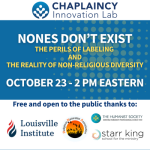 Our roundtable itself offered an educational program out of our conversations, with Ben Iten presenting the webinar “Nones don’t exist: The perils and labeling and the reality of non-religious diversity,” which was open to the public and will remain accessible on the website of the Chaplaincy Innovation Lab. The webinar began with the fundamental premise that the way we describe those who do not assume any of the historically religious labels often used in survey data is deeply flawed, and Ben offered actionable ways to think and talk with friends, family members, and colleagues who do not describe themselves as “religious.”
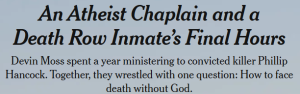
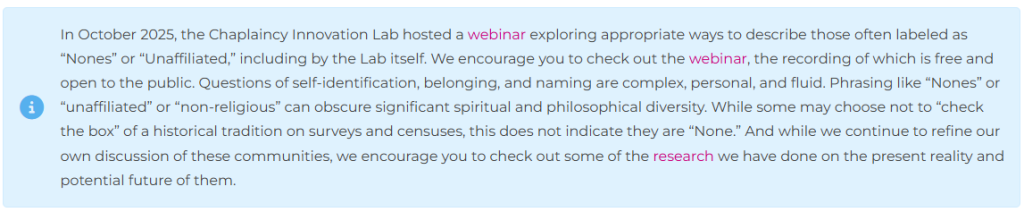
Earlier work by the Chaplaincy Innovation Lab provides a glimpse into how this works in the real world. In June 2024 the Lab hosted Devin Moss, atheist chaplain and creator of the Memento Mori podcast, to discuss his prison accompaniment of Phillip Hancock, a fellow atheist who was convicted of murder and executed in November 2023. The Lab also offers resources in classroom education and professional credentialing for those who wish to pursue chaplaincy as a profession beyond the boundaries of religious identity. In this, however, the Lab acknowledges its own previous complicity in the oversimplification of religious/philosophical descriptions; rather than remove its usage of the outdated phrase “Unaffiliated Chaplaincy,” it has instead inserted an informative message about how this context of care for the human spirit can be discussed more ethically and fruitfully.
Other roundtable participants’ institutions are also working to advance a vision of American society in which religious / non-religious labels and categories are less significant. Interfaith America, where Suzanne Watts Henderson services, offers “The Learning and Action Bridge,” a hub for self-paced courses and other resources on the importance of embracing American religious and philosophical pluralism. An excellent example is the free course “We Can Build Bridges,” which begins from the acknowledgement of “deep differences” in our communities but also assumes these deep differences can be bridged. And the way Interfaith American discusses religion as a concept is a model for understanding religion’s role in society in a non-conflicting manner: academic study, rather than devotion or practice; awareness without pressuring for acceptance; exposure to views without imposing any of them; education instead of promotion; and informing learners rather than pushing for conformity.
Furthermore, Interfaith America deploys these principles in thinking about religion in major American social contexts, including higher education, the corporate word, social and community service, and clinical health. Interfaith America also educates learners on the vital place of non-religious people as equal partners in interfaith dialogue and conversation:
Not all non-religious people identify as atheist, agnostic, or secular humanist. They may identify as spiritual, secular, formerly religious, never religious, some combination, or something else entirely. It is still important to include people’s perspectives, values, and beliefs about the world even if they do not fit into a neat category. If someone says they’re not religious, it is best to respect their self-description. You can still talk about formative experiences and what’s important to them in the context of interfaith cooperation.
Welcoming the participation of non-religious individuals and communities as part of interfaith dialogue is part and parcel, in Interfaith America’s view, of interfaith literacy.
So what?
Starting from the premise that we should primarily pay attention to how many Americans claim which labels makes it difficult to conceive of how religious and non-religious individuals and organizations can work together for the betterment of their communities. What is there to be done together when we disagree on the very foundations of why we are here and what we should do with our lives?
The conversations our roundtable enjoyed, and the work each of us does in our own institutions, suggest that the answer lies precisely in those fields of professional spiritual care and spiritual innovation. Jason Callahan, a board-certified chaplain endorsed by The Humanist Society, pioneered the creation of a simple referral resource within Virginia Commonwealth University Health. VCU’s so-called “Yellow Card” helps both patients and staff understand the availability of spiritual care for anyone and everyone; Jason further advised the Chaplaincy Innovation Lab on a loose guide for other institutions to create their own informational resources on the availability of spiritual care.[1] The categories of potential need that the resource includes can be experienced by anyone, regardless of their belief system – and can be addressed by any chaplain, regardless of the chaplain’s own belief system. These include:
- Anxiety, fear, dread, or uncertainty about diagnoses or treatments
- Making meaning of what is happening to the patient
- Non-therapeutic emotional support
- Discussing the need to make decisions about treatment, individually or as a family or group
- Impending death, active dying, or recent death
This approach begins from present circumstances and “zooms out” to include religious or philosophical belief only if the patient or caregiver raises the matter.
Ongoing work by other roundtable participants – such as Joseph Tucker Edmonds on the experience of Black men and social trauma, Kara Faris on the organizational and institutional needs of Christian congregations, and SueJeanne Koh on interfaith collaboration on climate change – falls well within the goals of the spiritual innovation mentioned above: addressing “longing for meaning, rootedness, belonging, resilience, care, and connection.” To return to our title: “Charts don’t matter – but relationships do.”