Sponsored by Fetzer Institute and Louisville Institute

Underserved and Marginalized Chaplains
The Fetzer Institute has long supported the Chaplaincy Innovation Lab’s efforts to support and build networks of and for chaplains who have historically been underserved in or marginalized by the profession, in terms of education, professional development, and professional advancement. The resources and information below describe some of the work the Chaplaincy Innovation Lab has done and continues to do in support these chaplains. This work was also supported by a Pastoral Study Project grant by the Louisville Institute in 2025-2026.
The resources described below, and indeed the Lab’s work to support these chaplains, is not described as comprehensive or all-encompassing. We encourage chaplains who believe their work is not covered by the resources below to contact us and begin conversation on possible ways to be supportive.

Landscape Study
In the summer of 2026, the Chaplaincy Innovation Lab launched a landscape study on the preparation and career advancement resources available to chaplains who do not describe themselves as religious (sometimes oversimplified or inaccurately referred to as “nones”; for more information on terminology, please review this webinar and accompanying working paper.) We explore questions including:
- What are the degree program and other classroom educational opportunities available specifically for, or particularly welcoming of, students who do not identify as religious?
- What Clinical Pastoral Education (or other field training) programs are available for chaplains who do not identify as religious?
- How do chaplains who do not identify as religious interact with the individuals, teams, and institutions in which they work, especially when they are in the philosophical minority?
- How do chaplains who do not identify as religious describe their work, both to other chaplains and the broader public, and do they think the way other chaplains describe that work is sufficient?
The purpose of this project is not to make normative determinations about the work of non-religious chaplains, but rather to identify areas where the profession can enhance its training and development of such chaplains.
A webinar reporting on this study, and featuring a conversation with a leading religiously unaffiliated chaplain, took place September 9 at 4 PM Eastern. You may view the recording here.
Dedicated Gathering Space
The Chaplaincy Innovation Lab offers a dedicated gathering space for chaplains who self-identify with underserved or historically marginalized backgrounds. Those interested in joining this private Mighty Network may indicate their interest here or below.
Mighty Networks application
Conversation Circles
Conversation Circles are one of the Lab’s longest-standing offerings to chaplains who elect to join a circle according to a variety of affinities. Most recently, the Lab offered two Conversation Circles for chaplains from historically marginalized communities.

An eBook describing this model, supported by Fetzer, is available here. The eBook addresses key components of the Conversation Circles model, including:
- How should a conversation circle be structured?
- Who should facilitate a conversation circle?
- What have chaplains found beneficial from this model?
- What have chaplains experienced as limitations of this model?
- How can this model cultivate community building?
Those interested in participating in a Conversation Circle may register their interest here.
Dialogue with Leading Voices
 The Chaplaincy Innovation Lab also remains in dialogue with leading voices in spiritual care education, field training, and practice. Most recently, this took two forms:
- A roundtable of six experts in academia, congregational support, non-profit education, and healthcare chaplaincy. You can view the webinar reporting on this roundtable below or here; a working paper resulting from this project is available here.
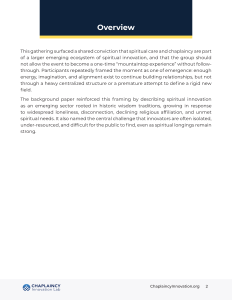
- A gathering at the Guest House Retreat Center in Chester, Connecticut to discuss the work of spiritual innovation in the United States today. Participants, who serve communities across the country in a wide variety of fashions, are dedicated to developing responsive spiritual care as “an emerging sector rooted in historic wisdom traditions, growing in response to widespread loneliness, disconnection, declining religious affiliation, and unmet spiritual needs.” A report from this gathering is available here. A public webinar discussing this and related work took place in August 2026 and can be viewed here or below.
If you want more information or would like to be involved with this work, please contact us at info@chaplaincyinnovation.org.
