Politics in the Spiritual Care Encounter
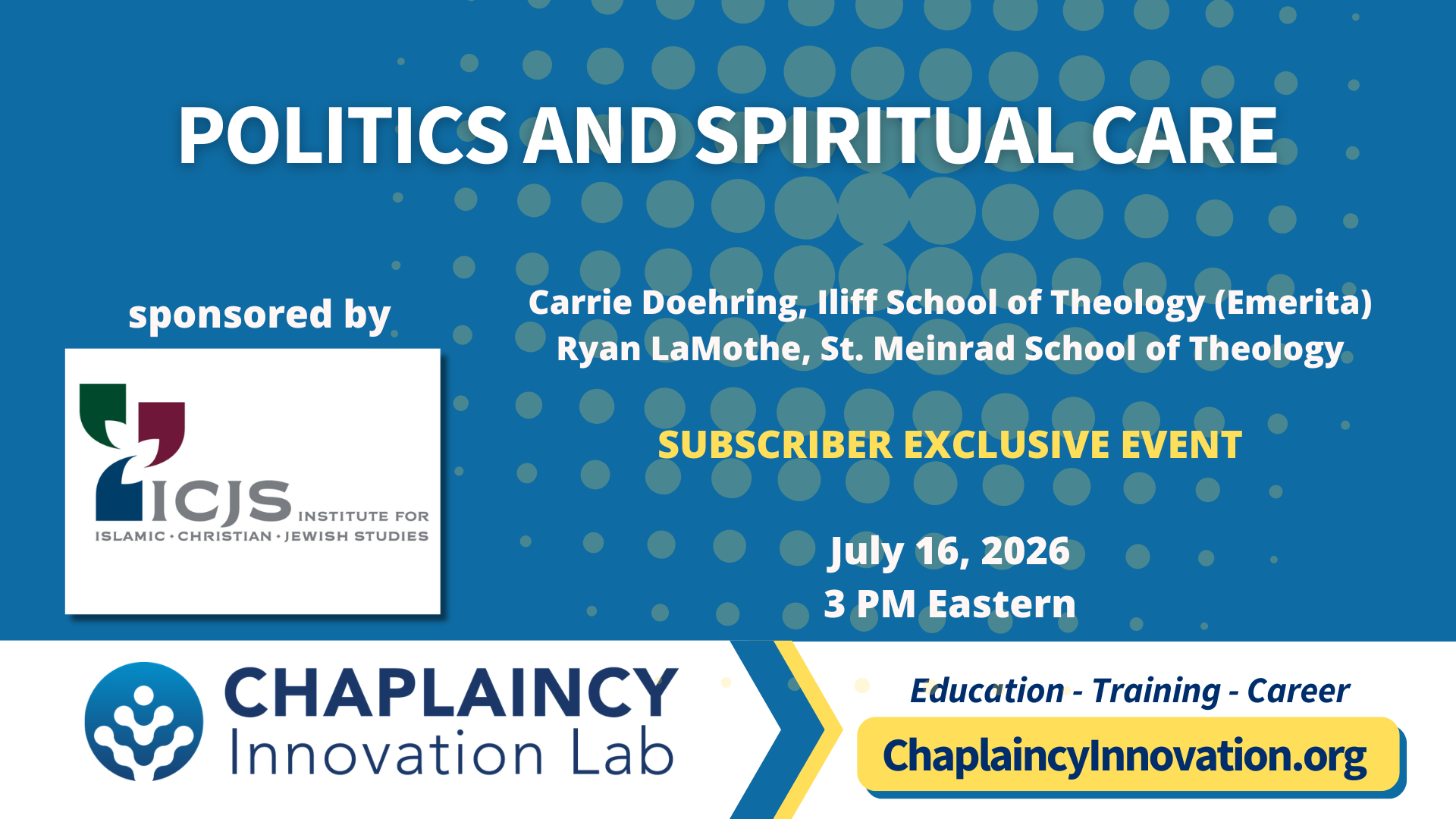
What happens when differences in political values and beliefs compromise spiritual trust and spiritually respectful care?
Our present moment is marked by widening political chasms, vociferous argument, and dehumanization. Chaplains are not immune to these dangers — not in their personal lives, and not even in the professional care they provide to individuals, families, and communities. Political differences involving moral foundations, core values, beliefs, strategies for change, and relational networks can take on a life-and-death urgency when chaplains try to establish spiritual trust and goals that are spiritually life giving and not harmful.
It’s no wonder that research highlights how often chaplains in the US experience intense stress involving moral and spiritual struggles.
Join the Chaplaincy Innovation Lab for a multidisciplinary webinar on how chaplains can best continue their vital work even when political disagreement and strife explicitly enters the care encounter. We’ll discuss self-care, the complex and contradictory nature of moral orientations for both chaplains and those they serve, and how to integrate time-tested skills of spiritual care into emerging and accelerating political differences that threaten caregiving relationships.
This webinar is sponsored by the Institute for Islamic, Christian, Jewish Studies. You can learn more at icjs.org, and we encourage you to keep an eye out for news about their 2027 conference.
We have indexed this webinar to the following learning outcomes. Our proposal of these outcomes should not be construed as endorsement of this event by ACPE, APC/BCCI, or any other professional association.
ACPE Category A: Spiritual Formation and Integration – Outcome 1: Narrative History – Level IA – IA.2 – Articulate awareness upon reflection of when a care encounter intersects with elements of one’s narrative history
ACPE Category A: Spiritual Formation and Integration – Outcome 1: Narrative History – Level IB – IB.1 – Articulate how one’s narrative history informs one’s values and beliefs about spiritual care
ACPE Category A: Spiritual Formation and Integration – Outcome 2: Socio-Cultural Identity – Level IA – IA.4 – Articulate awareness upon reflection when a care encounter intersects with elements of one’s social identity
BCCI Section II: Professional Identity and Conduct (PIC): PIC2 – Articulate ways in which one’s feelings, values, assumptions, culture, and social location affect professional practice
BCCI Section II: Professional Identity and Conduct (PIC): PIC3 – Attend to one’s own physical, emotional, and spiritual wellbeing
BCCI Section II: Professional Identity and Conduct (PIC): PIC4 – Respect the physical, emotional, cultural, and spiritual boundaries of others.
Carrie Doehring was on the faculty of Iliff School of Theology from 2003 until her retirement in 2024. She is a licensed psychologist in Massachusetts and Colorado, and ordained in the Presbyterian Church, USA. Her scholarship focuses on interreligious, socially just and research literate spiritual care of trauma, moral stress, and spiritual struggles.
Dr. Doehring is the author of over 50 chapters and articles, including the chapter “Practicing socially just, interreligious, and evidence-based spiritual care” in the volume edited by Wendy Cadge and Shelly Rambo, Chaplaincy and spiritual care in the twenty-first century. Dr. Doehring’s book book The Practice of Pastoral Care: A Postmodern Approach is used as a textbook in pastoral care and clinical pastoral education throughout the United States and Canada. She is also co-editor of Military moral injury and spiritual care: A resource for religious leaders and professional caregivers.
She has advised 26 doctoral dissertations and received Virginia Sexton Mentoring Award from the American Psychological Association. She also received the Senior Career Award from the Society for Pastoral Counseling Research in Canada. She has also received the medal from The Network on Ministry in Specialized Settings (COMISS), given in recognition of outstanding scholarship and leadership in teaching spiritual care.

Ryan LaMothe is professor of pastoral care and counseling at St. Meinrad School of Theology. Over the last 30 years, he has published over 200 articles and book reviews, as well as 14 books. These publications address topics in psychoanalysis, psychology of religion, pastoral counseling, pastoral theology, and, most recently, political pastoral theology.
He has lectured at universities in the U.S. as well as Europe and Asia. In 2017, he received the Springer Publishing Award “Transforming the World One Article at a Time.” Dr. LaMothe delivered the Jacob Neumann Lecture at Princeton in 2022. In 2024, he was nominated for the Gradiva award for his book A Political Psychoanalysis for the Anthropocene Age. He has served on three editorial boards of peer-reviewed journals and has served as president of the Society for Pastoral Theology.